On education
College was built for a world that no longer exists. A look into why the university model is failing students, what it's still good for, and what needs to change
tldr; Colleges have fallen behind the times and are no longer the cost proposition they once were, particularly in the US. A degree might get you in the room, though even that is harder than it used to be, but with 38% of Americans and ~44% of Europeans holding one, it no longer sets you apart. Colleges are structurally optimized for research output, not teaching — and curricula that couldn’t keep up with the last decade won’t keep up with this one. Curricula that do teach the fundamentals rarely show students how they apply, or how to adapt when the landscape changes. Think hard about where you go, what you study, and how you spend your time.
Growing up, I hated going to school. I dreaded doing my homework, rarely found the content interesting and sometimes even faked being sick. I like to think that’s a pretty common experience. Around middle school, things started to change. By 9th grade I had developed an appreciation for education and decided to apply to boarding school. What changed?
I think part of it was simple: I’ve always hated being bad at things. So I put in the work, got better, and realized that competence and knowledge are their own reward. The other part was curiosity: I read a lot as a kid (mostly fiction) and at some point I noticed that same curiosity could extend beyond books. By 9th grade it had, particularly towards coding and physics.
A year later, I became a sophomore at Hotchkiss, a boarding school in Lakeville, Connecticut. The student teacher ratio was about 4:1. Since classes were so small, many courses were structured around the Harkness concept. Harkness emphasizes active student participation, where learning occurs around an oval table and the teacher facilitates discussion rather than lecturing. To get an A, you had to apply concepts to problems you’d never seen before. Days were packed with class, athletics, and extracurriculars; hours of homework every night and weekly matches against other schools meant time was tight. Hotchkiss forced me to develop a real work ethic.
The curriculum gave you room to choose your own level of difficulty, and I chose the harder classes: advanced math, tough humanities electives. I wanted to be challenged, and once I committed I had to follow through. My grades took a hit, but I learned a lot more. Beyond academics, attending boarding school forced me to mature — managing my own travel, budget, and sleep for the first time. I was surrounded by people smarter and more driven than me, and it pushed me to be better. I loved it.
By contrast, I find my college experience quite frustrating. In more than one course, I’ve opened an assignment or the lecture slides only to see a due date in 2017 or 2018. Moments like that make the lectures feel stagnant: most offer nothing new, simply recycling last year’s slides that regurgitate the same content. Many courses are easy to pass, easy to game, and only require rote memorization to get a decent grade. At times, college feels like taking a step backwards.
The frustration isn’t personal: the college model just hasn’t kept up. It was designed for a world that no longer exists. To understand how we got here, let’s take a step back in time. (I use the word college and university interchangeably below. I am aware of the distinction.)
College before the 21st Century
Attending college used to be a no-brainer. Being college-educated gave you a significant competitive edge. You were able to learn material that wasn’t necessarily readily available to the public. Curricula couldn’t be digitally distributed. When my dad went to college in the 80s, it was common to pay someone for their class notes (in case you were sick or not paying attention). That model made sense when information wasn’t generally attainable and cheap.
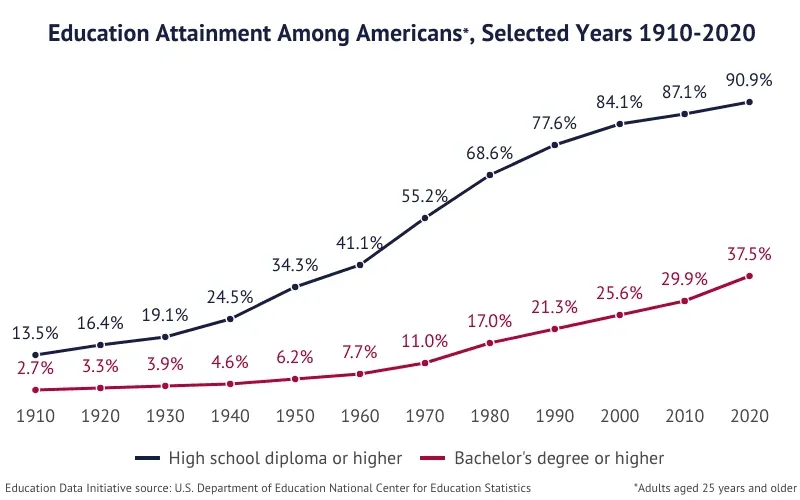
Education attainment among U.S. adults (ages 25+). Source: Education Data Initiative; U.S. Department of Education, National Center for Education Statistics.
But sometime in the early 2000s, the information monopoly broke. YouTube made MIT and Stanford lectures widely available. KhanAcademy was founded in 2008. YouTube, and the internet, were filled with notes and tutorials on many university classes. Most education videos on YouTube began receiving comments like these:

Example comment under educational videos on YouTube. Source:
YouTube

Another comment under educational videos on YouTube. Source:
YouTube
These online resources supplemented and reinforced learning, but did not replace it. They did, however, expose just how little many lectures were adding.
In 2026, it’s gone a step further. LLMs haven’t just exposed how little lectures add — they’ve commoditized the work itself. The essay, the model, the assignment: all delegatable in minutes. And it’s accelerating every day: we’ve gone from browsing the web and synthesizing knowledge ourselves, to asking a chat interface, to having agents act on our behalf — booking, researching, executing. The information monopoly broke in the early 2000s. Now the execution monopoly is breaking too.
Attending college does not give you the same competitive advantage as you got 20 or 30 years ago. So what are you actually paying for?
What College is actually selling
I think college really offers three things:
- Accreditation. Like graduating high school, attaining a bachelor’s degree is a general certificate of “competence”. It tells employers that you have some basic background knowledge regarding a certain field. At elite institutions, it also signals selectivity, not just competence.
- Network. You develop a network and meet other aspiring professionals in your field. At elite schools, that network punches well above its weight.
- Maturity. College is the first time living away from home for many people. It’s an environment where many students learn to manage their time effectively and become “adults”.
I think accreditation (and network at certain institutions) is what you’re really paying for. The degree is what allows most people to be hired after graduating, and at elite institutions, the return on that investment is demonstrably higher. But accreditation is breaking down. A credential only means something if it can reliably signal readiness — and the gap between what colleges certify and what employers actually need has grown too wide to ignore.
Where the College Model Fails
Sit in enough lecture halls and a clear pattern emerges: half the room is on their phone, the slides haven’t changed in years, and nobody’s asked a hard question in weeks. In 2026, information is abundant and free. Lecture halls offer little interactivity, personalization, or accountability. All students move at a uniform pace: some are bored, others are completely lost.
College was built in a time when the pace of change was slow. Historically, the skills needed in the labor market changed every couple of decades in large waves: the industrial revolution, electrification, the personal computer, the web. Each wave took decades to fully reshape the workforce, giving institutions plenty of time to adapt. In modern, fast-moving industries, tools and best practices can evolve every few years, and in some cases faster. Entire paradigms may shift within a single undergraduate degree cycle.
The problem isn’t that universities teach theory — theory is necessary and often timeless. The issue is that it’s rarely grounded in the current landscape. Students should understand how the theory has been relevant historically, how it applies today, and how it may change as the industry continues to evolve. That’s the difference between a class that changes how you think and one you will forget about a week after the exam. A student graduating who can recite theory but hasn’t had to apply or adapt it risks entering the workforce fundamentally unprepared.
Take software engineering. System Architecture and Algorithms are timeless. But cloud computing is still listed as an elective, not core, in the ACM/IEEE CS2023 curriculum guidelines while 76% of IT leaders report hiring challenges from skills gaps. Then AI-assisted development arrived and changed how software is built entirely. A graduate who has never deployed to the cloud, worked with containers, or used AI coding assistants is already behind. With autonomous agents maturing fast, the gap will only widen.
Marketing tells a similar story. The fundamentals — consumer psychology, campaign planning, positioning — don’t expire. But the channels where they play out shift constantly, new platforms emerge and creative formats cycle faster than any curriculum could track. Curricula adapt slowly: as of 2019, fewer than 10% of AACSB-accredited marketing programs required a digital marketing course . Then in 2021, Apple’s ATT dismantled the precision-targeting model that had defined performance marketing for a decade. Conversion-optimized Meta ads saw a 37% drop in click-through rates overnight. And the next shift is already forming: if AI agents begin handling purchasing decisions on behalf of consumers, the entire premise of reaching a human audience changes again. Curricula that couldn’t keep up with TikTok won’t keep up with that either. The lesson isn’t just that marketing changes — it’s that it will always change. What college should try to teach is how to orient yourself when it does.
Young adults with a college degree are currently entering one of the toughest job markets in recent history. The economy and AI play a role in this, but so does the growing gap between what college teaches and what employers actually need.
In the Fed’s 2024 outcomes table by major, computer engineering is at 7.8% unemployment (second highest rate listed), and computer science is at 7.0% with 19.1% underemployment. Even in high-paying technical majors, the path from degree to good placement is less automatic than it used to be. A lot of students studying software engineering or business assume the degree is enough — that showing up, passing the courses, and graduating will translate to a good job and good pay. For many, it won’t.
The Incentive Problem
Professors feel that tenure and promotions are tied to their research, not their ability to teach. Global university rankings are driven primarily by the university’s research environment and research contributions, not teaching quality.
The result is an institution structurally optimized for everything except preparing students for a fast-moving world.
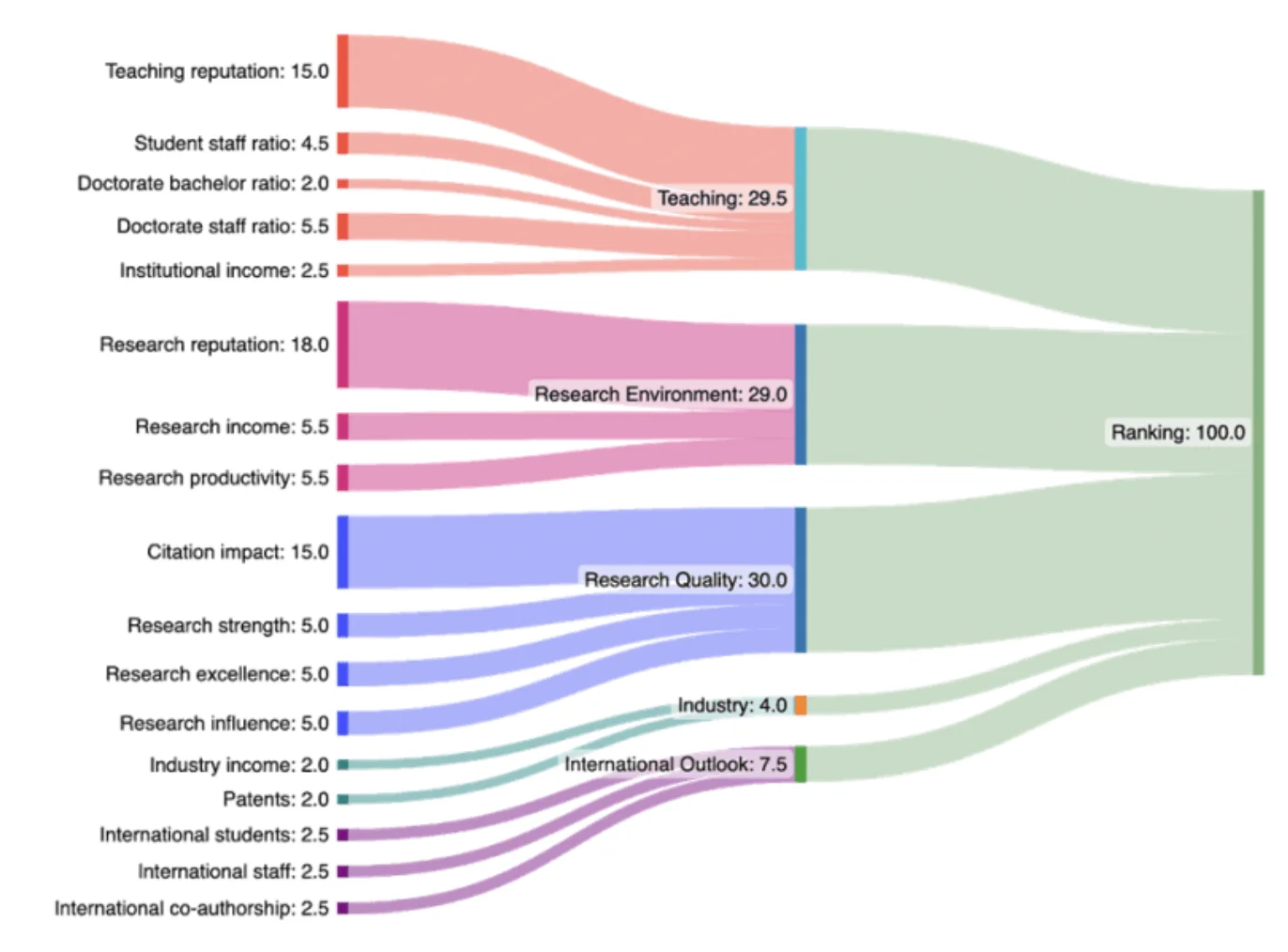
Times Higher Education world university rankings methodology breakdown. Source:
THE Methodology
Listening to Gavin Baker - Nvidia v. Google, Scaling Laws, and the Economics of AI through Root recently, one segment stuck with me:
Fortune 500 companies are always the last to adopt a new technology. They’re conservative, they have lots of regulations, lots of lawyers. Startups are always the first. So let’s think about the cloud, which was the last truly transformative new technology for enterprises… I think the first AWS reinvent, I think was in 2013, and by 2014, every startup on planet Earth ran on the cloud. […] The first big Fortune 500 companies started to standardize on it like maybe five years later. You see that with AI.
It captures a pattern: startups move first and large enterprises follow years later. Universities don’t even really show up on that timeline. The institutions whose entire purpose is the pursuit of knowledge are somehow the least equipped to keep up with it.
LLMs have made this worse. I can complete most of my assignments with an LLM and get a decent grade without thinking deeply once. The degree increasingly certifies that you showed up, not that you learned anything.
Andrej Karpathy, a founding member of OpenAI and former Director of AI at Tesla, famously said, “AI is good at anything that is verifiable.” Much of undergraduate work — essays, coding assignments, financial models — is verifiable. And yet, universities continue to price and structure degrees as if the scarcity of that kind of work hasn’t fundamentally changed.
It All Falls Apart in North America
In the US, I find this issue impossible to ignore.
Given the lower competitive advantage of attending college, it is insane that tuition continues to outpace inflation. Since 1963, inflation-adjusted tuition has increased by over 300%. As of writing, the US Student Debt totals over 1.8 Trillion USD. It’s one of the only forms of debt you can’t get rid of via bankruptcy.
There are various theories on why tuition has continued to balloon: lack of government funding, administrative bloat, etc. The cause is debatable. The result isn’t. A degree that returns less than it used to costs more than ever.
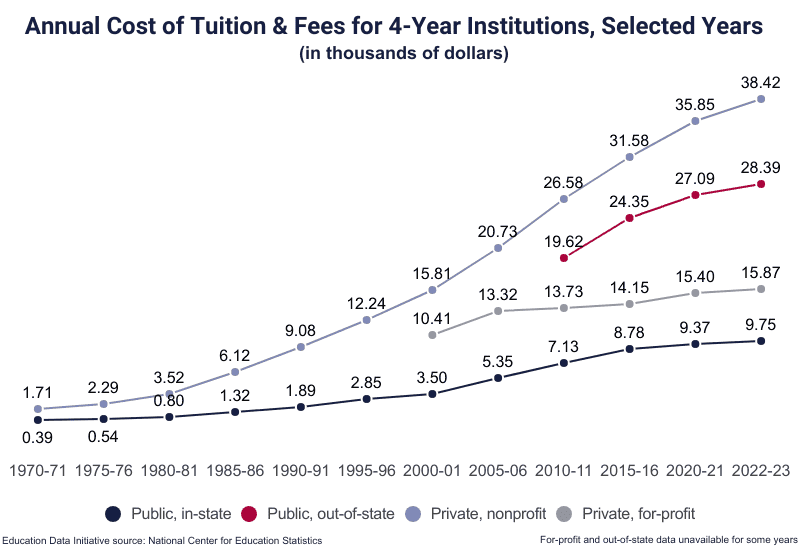
Annual cost of tuition and fees for 4-year institutions (in thousands of dollars), selected years. Source:
Education Data Initiative
In Europe, where tuition is heavily subsidized, a weaker credential is still a defensible investment. In the US, you’re paying a premium price for a depreciating asset. That’s not just a personal problem. It’s a systemic one.
The Future
College doesn’t prepare you to be a professional: it teaches you how to be a student.
Colleges should encourage discussion-based classes, test students on novel problems and hold them accountable. Have them work cross-discipline: engineers with business, with marketers, with designers to build or pitch a real product in large teams. Force them to think outside of the box and leverage all the tools available to get shit done. This mimics the work environment significantly better and will produce a generation of students who can creatively find solutions.
Colleges should routinely ask themselves:
- Can an undergraduate make a real impact at an employer after 6-8 weeks?
- Do our students understand how to disagree productively?
- Can they learn on the job once they complete their degree?
- Are we giving students a return worth the time and money they spend to go here?
They then should experiment and see what works. Here are two things they could start doing tomorrow:
- Survey last year’s graduates — both employed and those struggling to find a job — on what tools or skills they wish they’d been exposed to in college. Build pilot programs or electives around the answers. Repeat annually.
- Flip the lecture — assign theory as homework and use class time for questions, group work, and problem solving. The content is on YouTube. The professor’s time could be better spent helping students apply what they learned.
If colleges won’t reform, I hope the market will do it for them. I’d love to see startups in the education space applying some pressure. How can we make accreditation and test taking cheaper for people and viable for employers to accept? How can we leverage technology and AI to help people learn? It’s particularly frustrating since there have never been more resources available to learn anything you want — platforms like Udemy and Coursera have made structured, professional-grade learning accessible to anyone with an internet connection.
If schools and universities can’t figure out how to adapt, we’ll be teaching a whole generation of kids that thinking is now optional.
Where does this leave us
The future of most professions is genuinely uncertain right now. LLMs have gotten so good that most knowledge work jobs are just some good tooling away from serious disruption. If this will lead to fewer jobs, or more jobs as companies strive to stay competitive, isn’t quite clear to me yet. What is clear is that the skills worth having are changing fast. In that environment, curiosity has become a competitive advantage — it makes an uncertain, fast-paced world interesting rather than frightening. That’s precisely why what you learn in college, and how you learn to learn, is more important than ever.
If you’re in college or heading there: think hard about where you go and what you study — that still matters. But more importantly, put yourself in situations where you’re actually learning, not just credential farming. Work on things you genuinely want to exist — interest is what lets you put in the hours, and the hours are what make you good. Work with people who push and inspire you. Become a more complete and interesting person, not just a more employable one. The people who will do well in an uncertain environment aren’t the ones with the highest GPA — they’re the ones who can walk into an unfamiliar situation, figure it out, and get things done.
What I had at Hotchkiss was a privilege — not just financially, but in a second, less obvious way: most kids had chosen to be there. That matters. But what it showed me is that the model itself — small classes, discussion-led learning, real accountability — doesn’t require an insane tuition. It requires institutional will. That’s what’s missing.